
Rules and ethics
Part of Appointment setting for accountants: how to pick a UK agency
Appointment setting for accountants: how to pick a UK agency
How UK accountancy firms can vet appointment setting agencies on data protection, confidentiality, script safety and professional body expectations.
What to take away
- An accountancy-ready agency and a general B2B agency differ on data handling and script language, not on dialling volume.
- Ask for the lawful basis behind every contact and a data processing agreement before you sign.
- Callers must not quote fees or hint at tax outcomes, and no script should imply endorsement by a professional body.
- Verify the company at Companies House, then test the team on a paid pilot with a defined pass mark.
- Your professional body rules come first; an agency contract cannot override them.
Where general B2B agencies come unstuck
Accountancy is a considered purchase, and most enquiries arrive when a business is already comparing two or three firms.
That changes what a good appointment means. A meeting with a business that files dormant accounts may be worth nothing to a firm whose work is audit and advisory, however neatly it was booked.
General B2B agencies optimise for volume, because volume is easy to report back. The exposure sits in the data behind that volume and in the words the caller uses.
Data protection is the first filter
The Data Protection Act 2018 and the UK GDPR set out how personal data may be handled in the UK, and the Information Commissioner's Office (ICO) enforces them. The rules apply to an outbound marketing call as much as to a client file.
A compliant agency can name the lawful basis for contacting each prospect and produce the record on request. If the answer is a shrug, the campaign is not ready.
Ask for three documents: a data processing agreement, a retention schedule and a description of how the list was built.
The CAP Code also requires marketing claims to be substantiated, so treat a guaranteed appointment rate as something to test rather than a benefit to enjoy.
A vetting checklist for accountancy campaigns
Work through our questions to ask an appointment setting agency before you discuss price, then add the accountancy-specific checks below.
Accountancy agency vetting checklist
- Check filing history at Companies House
- Name your firm as controller
- Get lawful basis in writing
- Read script aloud for advisory language
- Confirm ownership of recordings and notes
- Set pilot pass markten accepted meetings
- Agree exit clause for data return
- Check the agency's filing history at Companies House and confirm the entity on the contract is the one you verified.
- Require a processing agreement that names your firm as controller and the agency as processor.
- Get the lawful basis for the pilot list in writing, list by list.
- Read the script aloud for advisory languageno fee ranges, no tax outcomes, no promised savings.
- Confirm who owns the recordings and call notes, and when the agency must delete its copies.
- Set a pass mark for the pilot, such as ten accepted meetings that fit your ideal client profile.
- Agree an exit clause that stops all calling and returns the data within a fixed number of days.
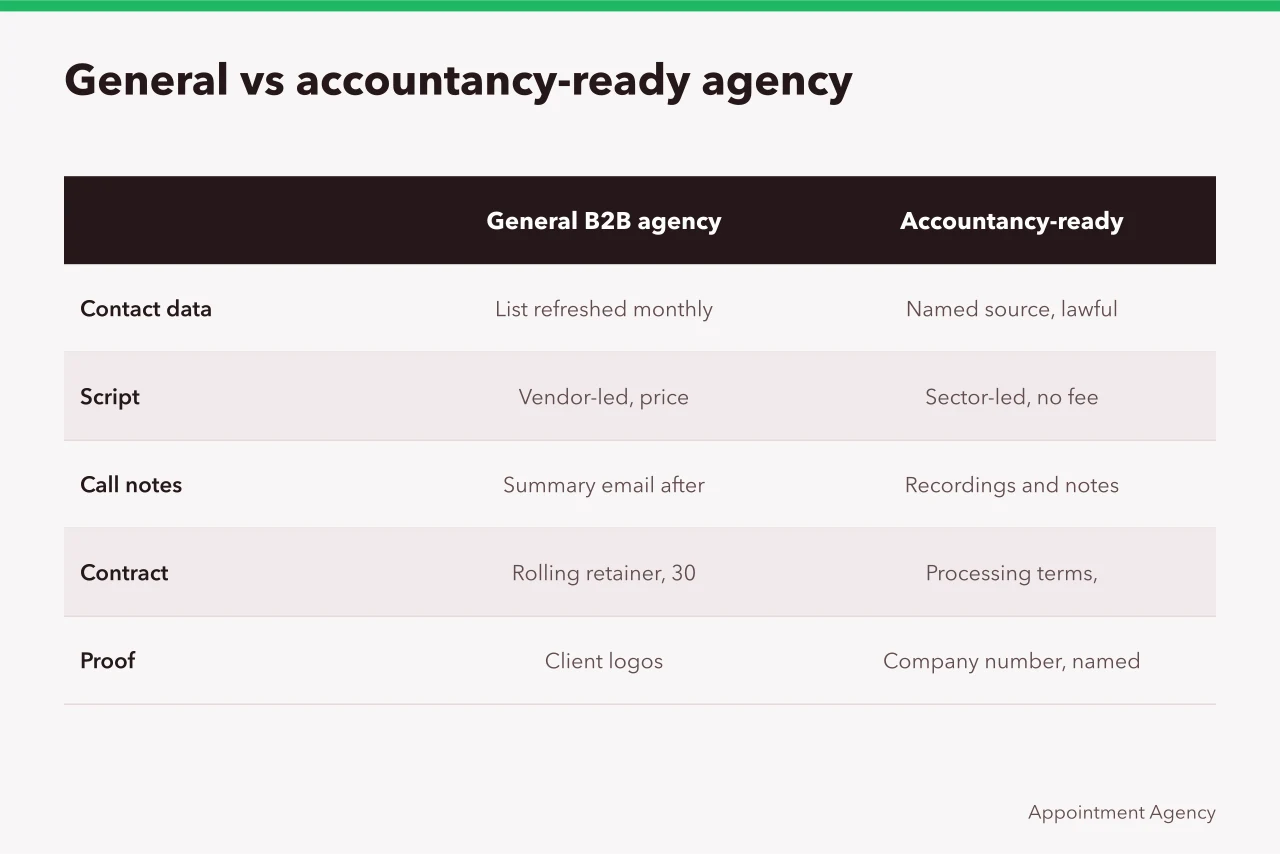
What to compare before you sign
General B2B agency
- Contact data
- A list, refreshed monthly
- Script
- Vendor-led opener, price framing
- Call notes
- A summary email after the campaign
- Contract
- Rolling retainer, 30 days' notice
- Proof
- Client logos
Accountancy-ready agency
- Contact data
- Named source, documented lawful basis, retention date
- Script
- Sector-led opener, no fee talk, no tax outcomes
- Call notes
- Recordings and notes returned to the firm
- Contract
- Processing terms, deletion schedule, exit clause
- Proof
- Company number, named callers, professional services references
Two signals carry the most weight in practice: who owns the data, and who decides what counts as a qualified meeting. An agency that answers both without hesitating is usually the one worth shortlisting.
Pricing, pilots and the exit
Most agencies sell a monthly retainer or a pay-per-appointment rate, and the two behave differently once quality slips.
Worked example, using illustrative figures. A quote of £45 per accepted meeting sounds disciplined. Twenty meetings a month is £900. If six match your ideal client profile, each useful conversation has cost £150 before a partner's time.
Our guide to how pay per appointment pricing works in the UK sets out the trade-offs against a retainer, including what to do when a rate looks unusually low.
A paid pilot of four to six weeks gives both sides an exit. Fix the definition of an accepted meeting in writing, and agree who counts it.
Common questions
Is cold calling business prospects allowed under UK data protection law?
Live business-to-business calls are permitted, but the Privacy and Electronic Communications Regulations (PECR) apply and the rules differ for sole traders and partnerships, which are treated as individuals. The agency must screen corporate numbers against the Corporate Telephone Preference Service (CTPS) and know which regime applies to each list. Ask it to set that reasoning out in writing.
Can an agency use our existing client list?
Only with your agreement, and only where marketing fits the purpose the data was collected for. Clients who have opted out should be excluded.
What should the contract contain?
A processing agreement, a deletion schedule, ownership of call notes and an exit clause. It should also bar subcontracting to overseas call centres without your written consent.
Do we need to tell our professional body?
ICAEW, ACCA, CIMA, ICAS, CIOT and AAT members follow ethical codes that cover confidentiality, and there is no separate notification to make for outsourcing. The work stays with the firm, so keep a written record of your due diligence.