
Audience research
How to run audience research for appointment setting agencies
Audience research for appointment setting agencies: how to define the buying group, combine desk and field methods, and turn findings into a targeting brief.
What to take away
- Audience research for appointment setting agencies is the structured process of identifying which companies and people are worth contacting, what they care about, and how they prefer to be approached.
- A usable definition of your audience has three layersfirmographics (company size, sector, location), the buying group (who signs, who influences, who blocks), and trigger events that create demand.
- Desk research from published government and industry data gives you a first hypothesis cheaply; primary research with real buyers confirms or kills it.
- The output is not a report but a targeting briefnamed segments, qualifying questions, objection notes and a contact cadence.
- Review the brief quarterly. Job titles, budgets and buying committees shift faster than most agencies assume.
Start with a one-page audience definition
Before booking a single call, write down who you are trying to reach in one page. If the definition runs longer, it is probably two audiences wearing one coat.
One-page audience definition
- Sector named
- Employee or turnover band
- Geography
- Operational problem solved
- Shared and editable
The page should state the sector, employee or turnover band, geography and the operational problem your client solves. For example, a client selling scheduling software might target UK dental groups with three to ten practices, not "healthcare".
Specificity matters because appointment setters are paid to start conversations, and a vague list wastes dials. A tight definition also makes the research testable: you can check whether the firms you named actually exist in the numbers you assumed.
Look at the evidence you already hold before you gather more. Existing client wins, lost deals and inbound enquiries all show which slices of the market convert, and which ones only look promising on paper.
Keep the definition in a shared document that both the client and the calling team can edit. Research that lives only in a slide deck gets ignored within a fortnight.
Map the buying group, not just the job title
Most B2B purchases involve more than one person, and appointment setting fails when it targets only the person who signs the contract. Map three roles: the economic buyer, the daily user and anyone who can quietly veto the deal.
Buying group roles and worries
Economic buyer
- Example
- Operations director
- Worry
- Payback period
- Use
- Budget approval
Daily user
- Example
- Shift supervisor
- Worry
- Fewer manual steps
- Use
- Adoption
Potential blocker
- Example
- Site gatekeeper
- Worry
- Access and disruption
- Use
- Veto risk
In a mid-market manufacturer, for instance, the operations director may hold the budget while a shift supervisor controls access to the site. A call that reaches only the director often stalls at implementation.
Write down what each role worries about. A finance lead wants payback periods; a team leader wants fewer manual steps. Those worries become the opening lines your setters test.
Committee size tends to grow with deal value. A contract worth £5,000 a year may need one approver, while a £50,000 deal can pull in four or five people.
This mapping also tells you who to exclude. Contacts with no influence and no budget access inflate activity metrics while producing nothing. Our guide to appointment setting agencies target audience walks through the segmentation choices that sit underneath this step.
Use desk research to build a cheap first hypothesis
Desk research is anything you can learn without speaking to a buyer. It is fast, inexpensive and good enough to shape a first calling list, provided you treat it as a hypothesis rather than proof.
Four desk research sources
Source
- Government data
- Small business practices
- Sector bodies
- Operational detail
- Marketing institutes
- Messaging language
- Platform data
- Targeting attributes
What it gives
- Government data
- Sector bodies
- Marketing institutes
- Platform data
Government data is a sensible starting point. The Small Business Survey reports published by GOV.UK include findings on small business practices and the barriers owners report, which helps you judge whether a segment is likely to buy external help at all.
Sector bodies and trade press add operational detail that statistics miss. If your client sells to hospitality groups, the tourism industry data from the Office for National Statistics gives you seasonality and business counts you can use to size a territory.
Marketing institutes publish strategy and audience material that sharpens your messaging. The articles, news and reports from the Chartered Institute of Marketing are useful for framing propositions in language buyers already recognise.
Platform data is the fourth desk source. LinkedIn's audience targeting guidance explains how professional attributes such as seniority, function and company size can be combined, which is directly relevant when you build a prospect list.
Set a time box for this stage. Two days of desk work should give you a segment list, a rough size per segment and three or four assumptions worth testing.
Log where each fact came from, including the date it was published. Figures age quickly, and a client will ask where a number came from before they repeat it to their own board.
Run primary research with real buyers
Primary research means talking to people who resemble your client's buyers. Twenty well-chosen conversations beat two hundred survey responses from the wrong job titles.
Primary research sequence
- Recruit existing customers
- Add lost deals
- Add cold contacts matching profile
- Test language in first ten calls
- Record objections verbatim
Recruit from the client's existing customers first, then from lost deals and finally from cold contacts who match the profile. Offer a short, specific reason for the call: you are reviewing how teams in their sector handle a particular problem.
The first ten conversations should test language, not validate your ideas. Ask how the buyer describes the problem in their own words, what triggered them to look for help, and who else got involved in the decision.
Record objections verbatim. "We already have an internal team" and "we tried an agency and it did not work" are different objections and need different handling scripts.
Listen for the words buyers avoid, as well as the ones they use. If nobody in a segment says "lead generation", writing that phrase into a script marks your caller as an outsider.
Our walkthrough of appointment setting agencies customer interviews covers question design and how to avoid leading the witness, which is the most common way this stage produces flattering nonsense.
Choose survey and listening tools that fit the budget
Surveys are useful once you know which questions matter. They quantify what interviews revealed, and they give you a number you can put in a client proposal.
Survey design limits
- 8-12questions per survey
- 1open question on biggest obstacle
- 9repeats before a comment is a finding
Keep surveys short: eight to twelve questions, mostly closed, with one open question about the biggest obstacle. Response rates fall sharply beyond that, particularly with senior respondents.
Combine survey data with listening data. Website enquiries, call recordings, live chat transcripts and email replies all contain language you can mine for messaging.
Code free-text answers into themes before you quote them. A single vivid comment is an anecdote; the same comment appearing nine times is a finding.
If you are comparing platforms for this work, our review of appointment setting agencies survey tools sets out what each type of tool does well and where it adds cost without adding insight.
One caution: sampling bias is the main risk. If you only survey people who already reply to cold email, you will learn about people who reply to cold email, not about the wider market.
The Advertising Standards Authority and the Committee of Advertising Practice publish research on marketing practice and audience attitudes. It is worth reading before you write claims into a survey or a campaign, because it shows how evidence standards are applied in practice.
Turn findings into a targeting brief
Research that does not change a calling list has failed. Convert everything into a one-page brief with five sections: segments, qualifying questions, opening angles, objections and cadence.
Targeting brief sections
- Segments and monthly volume
- Qualifying questions under two minutes
- Opening angles in buyer language
- Objections with honest responses
- Cadence and do-not-contact list
The segments section names the firms you will contact and the volume you expect per month. The qualifying questions let a setter confirm fit in under two minutes.
Opening angles should quote the buyer's own language, not marketing copy. If buyers say "we are drowning in manual scheduling", use that phrase rather than "workflow optimisation".
Objections get a short, honest response each. Cadence states how many touches, across which channels, before a contact is retired.
Add a short do-not-contact list covering job titles and sectors that wasted time in the last cycle. Setters follow a brief more closely when it tells them what to skip.
Circulate the brief to the calling team and the client. Any disagreement about the audience surfaces here, before anyone has dialled, which is far cheaper than discovering it at week six.
Keep the research honest and current
Set a review date the day you finish. A quarterly review is realistic for most B2B sectors; fast-moving technology markets may need it monthly.
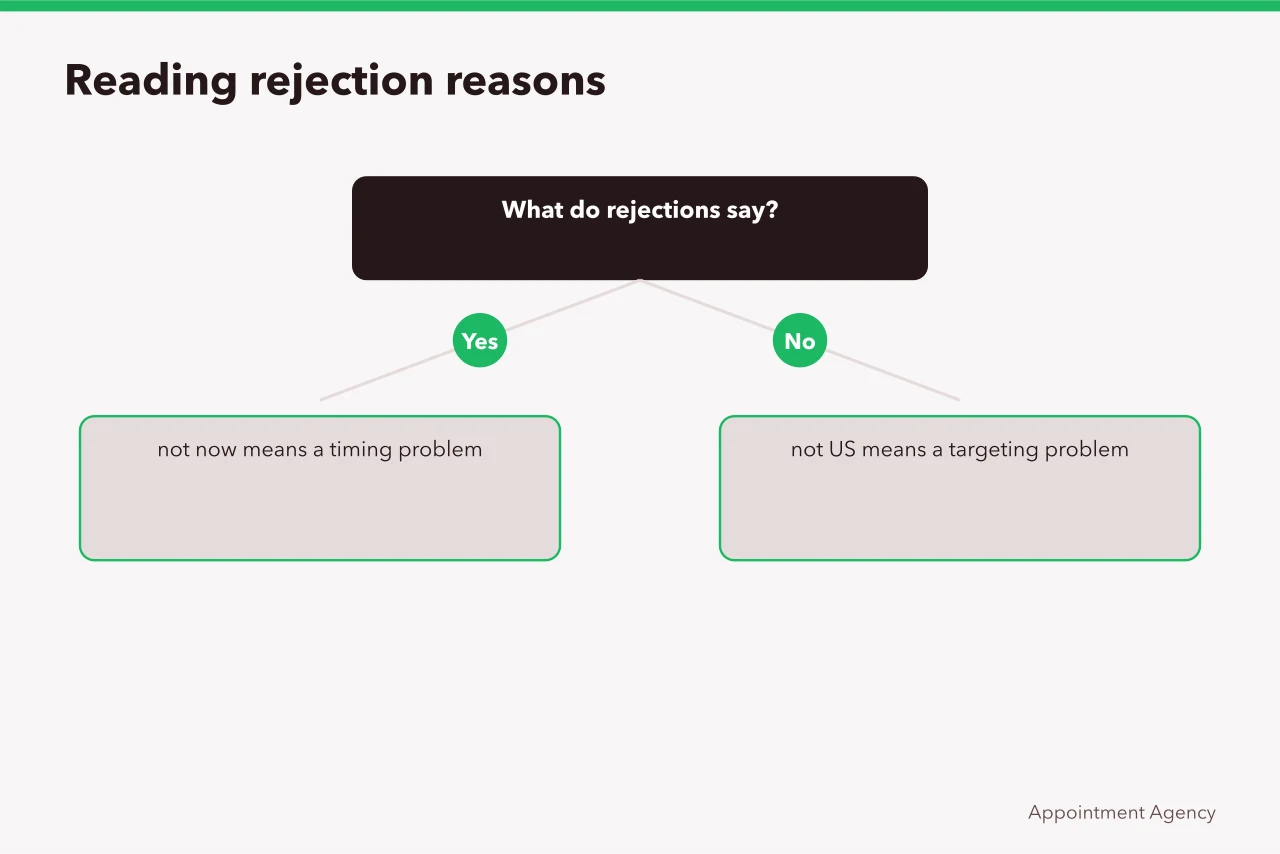
Track three signals between reviews: connect rates by segment, meeting acceptance rates and reasons given for rejection. Falling connect rates usually mean the list has gone stale or the numbers are wrong.
Rejection reasons are the most valuable and most ignored data in appointment setting. If half your rejections say "not now", you have a timing problem; if they say "not US", you have a targeting problem.
Keep a written changelog. When a segment is dropped, note the date and the evidence. This stops the same failed segment returning six months later under a new account manager.
Record who was consulted in each round as well. Buyers change jobs, and their replacements often bring different priorities to the same role.
If the client buys lists or data from a third party, check the provenance and the lawful basis for contacting those people. UK data protection rules apply to B2B prospecting, and the Information Commissioner's Office publishes guidance on direct marketing that your client should be able to point to.
Checklist: audience research for appointment setting agencies
Audience Research Checklist
- One-page audience definition written, dated and shared with the calling team.
- Firmographic filters agreedsector, size, geography, technology or service in use.
- Buying group mappedeconomic buyer, daily user, potential blocker.
- Desk research completed from at least three independent sources, with publication dates logged.
- Assumptions written as testable statements, not conclusions.
- Twenty primary conversations booked with people matching the buyer profile.
- Objections captured verbatim and grouped by theme.
- Survey limited to twelve questions and sent only to qualified respondents.
- Listening sources reviewedenquiries, call recordings, email replies, chat transcripts.
- Targeting brief produced with segments, qualifying questions, angles, objections and cadence.
- Do-not-contact list agreed with the calling team.
- Review date set, with a named owner.
- Changelog started, recording what changed and why.
- Lawful basis for contacting each list confirmed with the client.
Where this fits in the wider programme
Audience research is one of four inputs into a working appointment setting programme. The others are competitor research, tooling and the target audience definition itself.
Competitor research tells you which claims are already crowded and where a client can differentiate. Our guide to appointment setting agencies competitor research covers how to gather that evidence without relying on guesswork.
It also shows which objections rivals have already answered in public, so your scripts do not rehearse settled arguments. That keeps the calling team focused on the points where the client genuinely differs.
In a crowded sector, the differentiator is usually proof rather than promise. Case evidence, response times and named references carry more weight than another claim about service quality.
Tooling determines how quickly research turns into booked meetings. Our tools and supplier guide compares the categories of supplier an agency might use, from data providers to dialling platforms.
Run the four inputs in order: audience first, competitors second, tools third, then a pilot. Reversing that order usually means buying software to fix a targeting problem.
Common questions
How long does audience research take?
For a single segment, two days of desk research plus three weeks of interviews and a survey is a realistic cycle. Multi-segment programmes take longer, so run segments in sequence rather than all at once.
How many buyer interviews are enough?
Ten to fifteen interviews usually surface the main themes. Stop when new conversations repeat what you have already heard rather than adding a new objection or trigger.
Do we need a survey if we have done interviews?
Not always. A survey is worth the effort when you need a defensible number for a client proposal, or when two segments look similar and you need to size them.
Who should own the research?
The agency account lead should own it, with the client's sales manager contributing customer access. Research owned solely by the client tends to stall when other priorities appear.
In this guide
- How appointment setting agencies define a target audience from one decisionHow appointment setting agencies can define a target audience from named evidence, test it against a live list, and review the rules before outreach.
- When to build appointment setting agencies buyer personasBuild appointment setting agencies buyer personas from CRM data, call notes and lawful basis records, with a checklist to keep the set usable.
- Customer interviews for appointment setting agencies: in-house or via a recruiterCompare running customer interviews for appointment setting agencies in-house or via an agency recruiter, with costs, a five-step method and inclusion criteria.
- Which survey tools do appointment setting agencies actually use?Compare the survey tools appointment setting agencies use, from SurveyMonkey and Typeform to Qualtrics, Alchemer, QuestionPro and panel providers.
- How to research appointment setting agency competitorsHow to research appointment setting agency competitors: frame the decision, scope the rival set, then check PECR, CAP Code and Companies House rules.